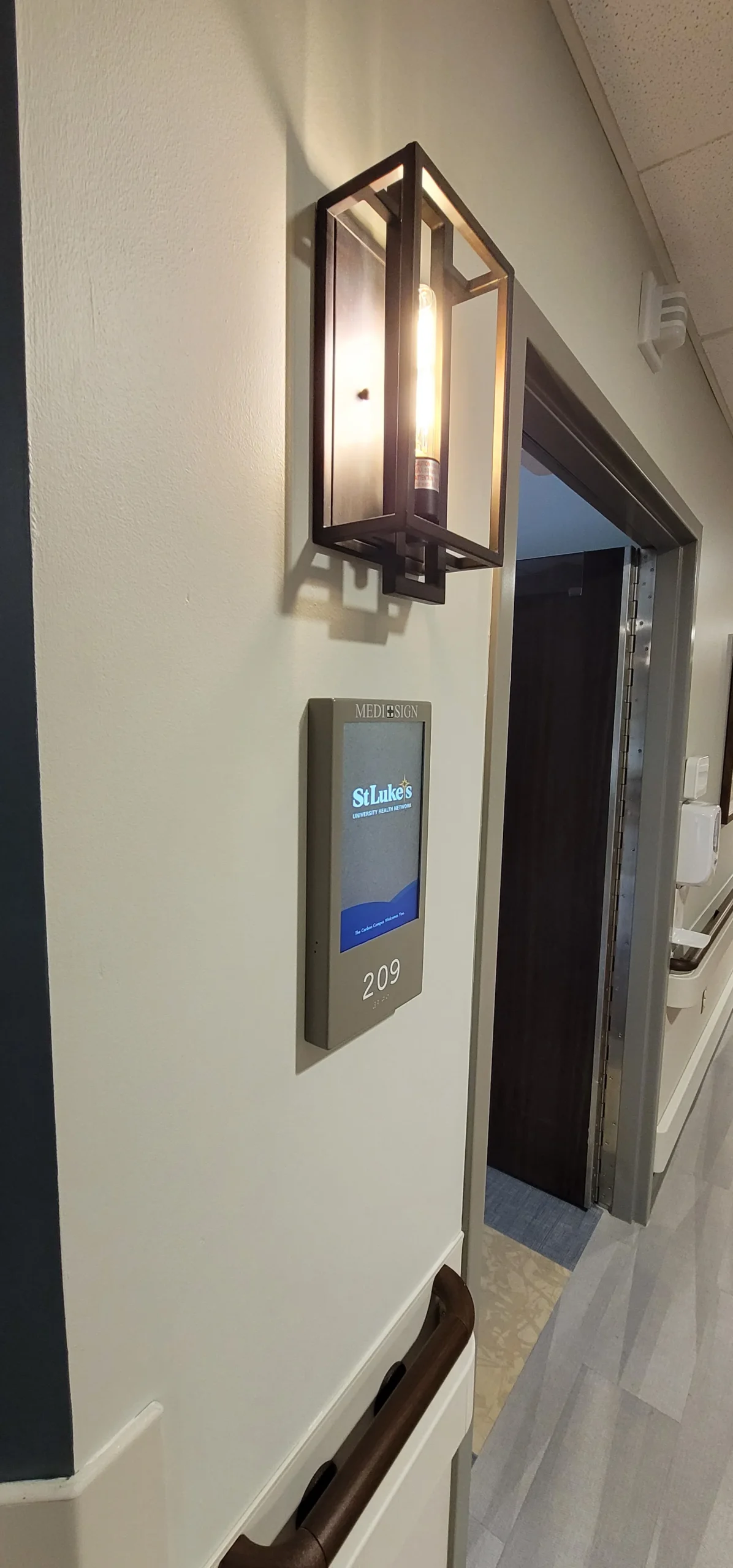
Technology that helps your staff reduce falls and improve patient safety.
Smart beds integrate with MEDI+SIGN ANTI-FALL™ technology to alert healthcare staff, patients and families of potential fall risks by sending alerts to the digital whiteboards in the patient’s room, in the hallway and at the nurses’ station. Alerts can range from bed height and bed rail position, to break checks and alarm reminders, and are determined based on the patient’s current fall risk.
Patent-pending algorithms use the information in the patient’s electronic health record to detect the patient’s fall risk and other factors, such as ventilation orders, and determine if the smart bed is in its safest position. The ANTI-FALL™ solution streamlines work processes and communicates updated and accurate alerts and information on the status of critical tasks relating to the care of individual patients and their safety.
The Average Fall-Related Injury Cost Per Patient is $24,962
22nd National Forum on Quality Improvement in Health Care Study for Saddleback Memorial Medical Center, Laguna Hills, CA
ANTI-FALL™ alerts help engage the patient and family in their own care with clear communication.

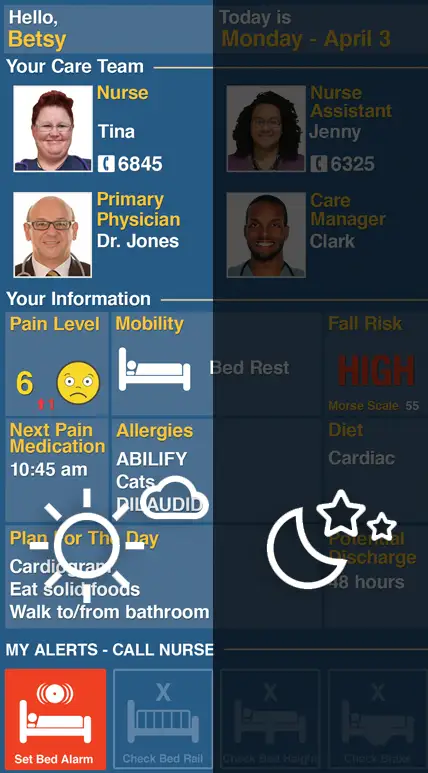
Our technology auto-adjusts screen brightness to the room for comfortable transitions between daytime and nighttime.
Cater your layout to the individual needs of your patients with content that is age and need specific.
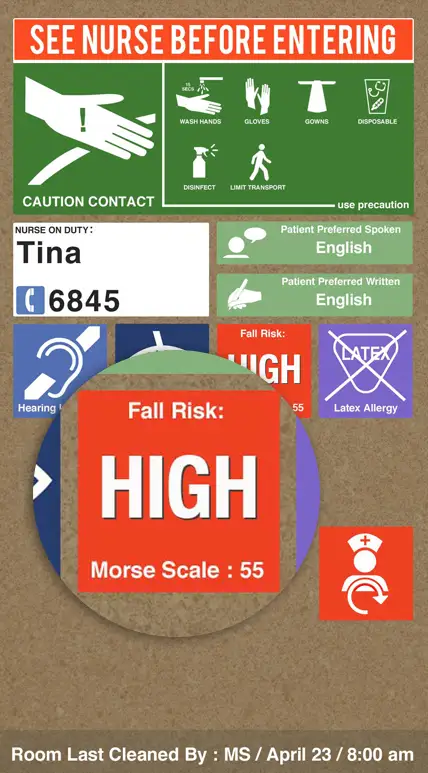
Easily display care team identification, clinical information, coordination, patient safety information and more.
For non-English speaking patients, MEDI+SIGN has the ability to automatically update information based on the patient’s preferred written and spoken language.
The digital patient room display with ANTI-FALL™ alerts will involve the patient and family in their own care by indicating fall risk status and any unsafe conditions, including bed alarm status, bed rail position, bed height and brake status. If the patient and their family members know about a safety conflict, they have the opportunity to ask the nurse for help and to understand what the conflicts mean and how they can avoid them.
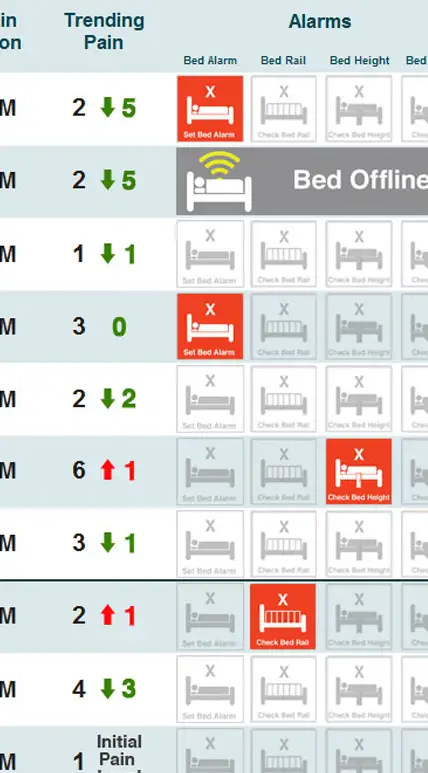
ANTI-FALL™ alerts are very useful outside each patient room. Any staff member can walk past a room and see if the bed alarm needs to be turned on in that room, or if a family member lowered one of the bed rails, bringing coordination of care to the next level. If the bed alarm is ringing in a patient room, an animated alert displays outside the room, making it obvious that the bed alarm is sounding in that room.
Patient Information in Real-Time
The simplified information and alerts are presented to patients in real-time and include their care team with pictures, role and name, diet, patient location, discharge status, average test time, radiology tests ordered, average lab time, and lab status. Special messages also appear when staff are paged to respond to an alert, notifying the patient that the staff are busy with another patient.

With ANTI-FALL™ technology at the nurses’ station, staff can determine if the patient is in bed or not and if the bed rails are in their safest position according to their assessed fall risk, as well as the bed height, bed alarm and proper bed angle settings. With all patient rooms available at a glance, bed-related safety conflicts have never before been easier to identify.
An Assessment of Falls in Patients’ Rooms and Methods of Prevention
Patient Whiteboards as a Communication Tool in the Hospital Setting: A Survey of Practices and Recommendations
Patient Whiteboards as a Communication Tool in the Hospital Setting: A Survey of Practices and Recommendations
An Assessment of Falls in Patients’ Rooms and Methods of Prevention
Patient Whiteboards as a Communication Tool in the Hospital Setting: A Survey of Practices and Recommendations
Patient Whiteboards as a Communication Tool in the Hospital Setting: A Survey of Practices and Recommendations


MEDI+SIGN can be customized to match your hospital’s existing aesthetics, including decorative wraps available for pediatric units, and the display can be automatically translated to the language of choice for the patient upon admission. The display’s backlighting automatically adjusts depending on the light in the room using Smart Sensors, in order to dim while the patient is sleeping or resting. This contributes to a seamless integration into your hospital and provides a comfortable atmosphere for the patient.
The information displayed on the MEDI+SIGN solutions can be customized for each hospital organization and for the unit in which it will be used. Each information block is simply a ‘widget’ that can be moved, added or taken away from the display.
Widgets are available for care team identification, clinical information, coordination and play of care and notes, as well as patient safety information, including fall risk, mobility, pain level and pain trend. More widgets are available upon request and can be customized for use in the emergency department, physical therapy and pediatrics. Enclosures are ADA compliant and can be matched to the hospital’s current furniture.
In order to improve the care of non-English speaking patients, MEDI+SIGN has the ability to automatically update the whiteboard information based on the patient’s preferred written and spoken language in the EHR.
Available languages include: English, Spanish, Russian, Hungarian, Slovak and Polish. Coming soon: Japanese, Chinese Mandarin, Cantonese, Arabic, French, French Creole, Italian, Ukrainian, Amharic, Zulu, Swahili, Korean, German, Swedish, Portuguese, Nynorsk, Turkish, Tagalog, Vietnamese, Hindi, Urdu, Persian, Greek, Gujarati, Bengali, Armenian, Hebrew, Telugu, Hmong.



MEDI+SIGN Headquarters
20940 Twin Springs Dr.
Smithsburg, MD 21783-1510 USA
The first step in finding your custom MEDI+SIGN® product starts here.